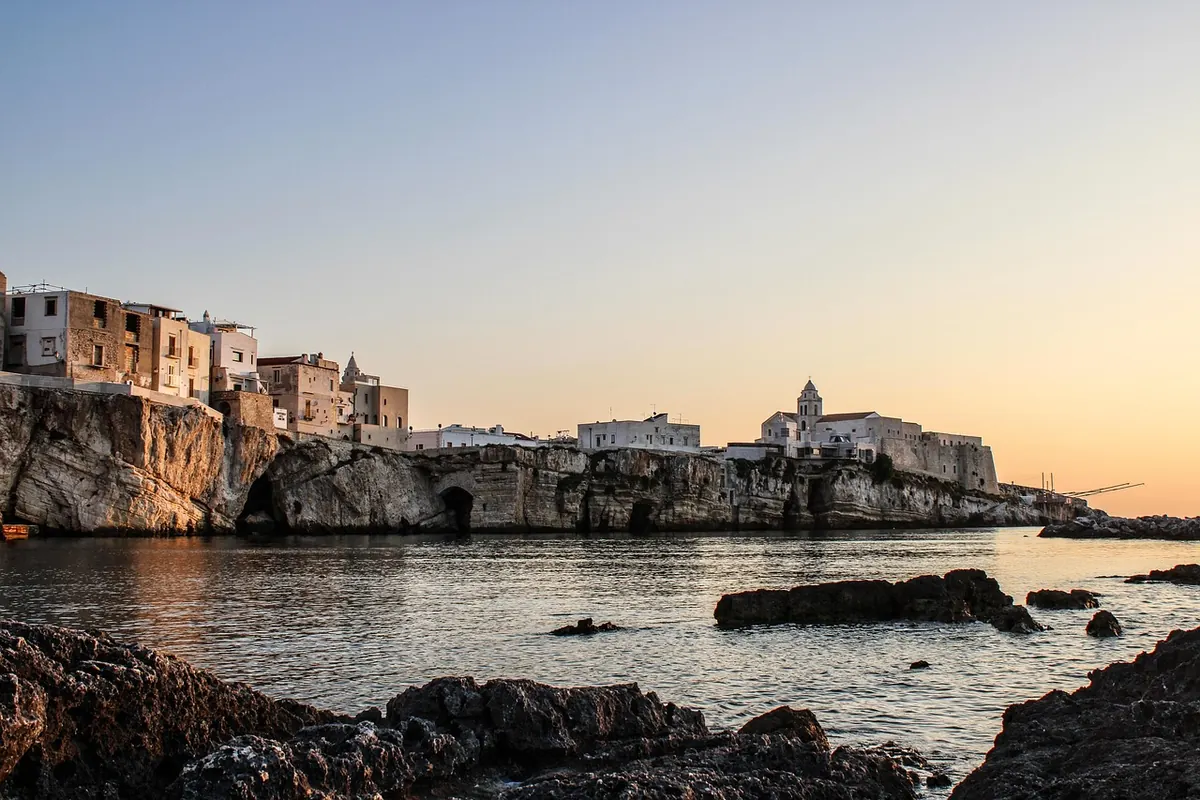
Puglia keeps two calendars. One follows the church — Christmas, Easter, the feast of a town's patron saint — and the other follows the fields: olives in November, grapes in September, tomatoes and artichokes in between. Because the two overlap so often, almost any week of the year there is a table set up in a piazza somewhere between the church door and the edge of the old town, and someone behind it is handing out something fried, something sweet, or something that has been simmering since dawn. The band is tuning up. The best shade has already been claimed.
None of this was arranged for visitors. Nobody sat down with a spreadsheet and a tourist board. The dates are older than the idea of tourism and will outlast it: a saint's day fixed in the seventeenth century, a harvest that arrives when the heat decides it will, a procession that turns left at a particular corner because it has always turned left. The honest way to describe a Puglian festival year is as a shape — a rhythm with loud passages and quiet ones — and the months below should be read that way. Check local notices the week you arrive. Ask at the bar. The truest thing about a local festival is that it moves.
Sagra, festa, fiera: how to read the calendar
Three words get used loosely by outsiders, and knowing the difference will change how you spend your evenings.
- Festa — a religious feast, usually for a patron saint. Expect a procession, a brass band, elaborate light installations (luminarie), fireworks, and a town that stays up far later than it should.
- Sagra — a food festival built around one ingredient or one dish. Long tables, paper plates, low prices, no ceremony. This is where you eat best.
- Fiera — an older, more commercial gathering: livestock, agricultural machinery, stalls, bargains. Less romantic, often more interesting.
The one to seek out is the festa patronale, the annual feast of the town's patron saint. It is the closest thing Puglia has to a village birthday, and the whole place reorganises itself around it for three or four days. If you can find out when a town's patronal feast falls and build a trip around it, you will see more of the region than any itinerary could show you.
The year, month by month
January
The year opens with fire. On 17 January, the feast of Sant'Antonio Abate, towns across the region build bonfires, and the one at Novoli, near Lecce, is the most spectacular — a brushwood tower the height of a building, lit with a ceremony that feels considerably older than the saint it honours. Smaller versions appear on the edge of squares everywhere: pruned olive branches, a match, a crowd, and someone selling warm frittelle. Epiphany on 6 January closes the long Christmas season with processions and, in some towns, a blessing of the sea.
February
Carnival. Putignano claims one of the oldest in Europe, with local tradition dating it to 1394, and its papier-mâché floats are carried through the streets with real craftsmanship behind the silliness. Gallipoli and Manfredonia hold their own, smaller and saltier. The food changes with the season: frittole, purceddhruzzi, fried dough in every shape the region can invent, eaten standing up in the cold.
March
Lent brings restraint for a few weeks, then San Giuseppe on 19 March breaks it with fritters and the first outdoor tables of the year. This is also when the artichoke is at its peak, and the Carciofo di Cerignola — huge, tender, protected — starts appearing in markets and on festival menus. Watch for sagre devoted to it in the Foggia plain.
April
Easter is the hinge of the year. Taranto's Holy Week rites are the region's most extraordinary spectacle: the Processione dei Misteri on Good Friday, hours long, solemn, genuinely moving rather than performed for an audience. Gallipoli holds a parallel set of processions. Then Easter Monday, Pasquetta, empties every town into the countryside with picnic blankets and torte pasqualine. Note that Easter moves, and with it a good part of the spring calendar.
May
On 10 May, Taranto celebrates San Cataldo, its patron, with a procession that ends at the sea. Across the region, May is the month of first communions, of small processions through whitewashed lanes, and of the first really warm evenings. Broad beans arrive with fresh pecorino — a combination so obvious once you have eaten it that everything else tastes like a mistake.
June
Bonfires return on the night of 24 June for San Giovanni Battista, the summer solstice dressed as a saint. Cherries come down from the Valle d'Itria, the first real tomatoes arrive, and the beaches fill on weekends. It is a good month to be in the small inland towns, where the evenings are still cool and the sagre have not yet been discovered by anyone outside the province.
July
Early July brings the feast of Santa Domenica at Scorrano, near Maglie, and with it some of the most elaborate luminarie in Italy — entire streets roofed in coloured light, built by specialist firms whose skills are handed down. In the wheat country around the Tavoliere, the harvest is finishing and the festivals that follow it begin. In the towns, everything happens after nine at night.
August
The loudest month. Ferragosto on 15 August, San Rocco on 16 August, and a dozen patronal feasts stacked on top of each other. The great one is the Notte della Taranta at Melpignano, in late August: a concert of pizzica that begins as folk revival and ends, by two in the morning, as something close to a mass trance. Book accommodation early, expect crowds, and understand that August in Puglia is a festival in itself.
September
The grapes come in, and with them the sagre dell'uva — grape festivals, must-scented, children stamping in vats, wine sold by the litre. In late September, Bitonto holds its great feast of the Santi Medici, and on 29 September pilgrims climb to Monte Sant'Angelo in the Gargano for San Michele, a site of devotion older than the town around it. The light changes; the sea stays warm.
October
The olive harvest begins, and the first oil of the season — green, peppery, almost bitter — starts to appear. Chestnut and mushroom festivals take over the Gargano. Sagre dell'olio nuovo begin in the olive belt between Bari and Lecce, where you can taste oil pressed that morning on bread that was baked before dawn. This is, quietly, one of the best months of the year.
In November the frantoio runs all night, and the whole town smells of cut grass and crushed olives. Nobody calls it an attraction. It is simply what happens.
November
Olives in earnest. The mills work around the clock and the festivals follow the harvest: sagre dell'oliva, new oil, winter vegetables, the first dark evenings. On 1 and 2 November, the feast of the dead brings its own sweets — fave dei morti, ossa dei morti, almond pastries named for bones. It sounds morbid and tastes wonderful.
December
On 6 December, Bari celebrates San Nicola, its patron, with a long and genuinely civic celebration that draws pilgrims from across the Orthodox world. Santa Lucia follows on 13 December. Then the Christmas season proper: living nativity scenes in half a dozen hill towns, markets in the centres, and the great Puglian sweets — cartellate drenched in honey, pettole fried and sugared, panzerotti eaten standing outside the shop that made them.
What to eat, and when
- Spring — artichokes, broad beans, wild greens, lamb, torte pasqualine.
- Summer — tomatoes, aubergines, orecchiette con le cime di rapa eaten despite the heat, figs, watermelon, granita.
- Autumn — grapes, must, chestnuts, mushrooms, the first new oil.
- Winter — olives, fave dei morti, honey-soaked cartellate, and anything involving a fireplace.
How to be a good guest
- Go early or go late. Festivals begin late and end later. Arriving at seven in the evening is arriving for the setup.
- Carry cash. A sagra stall that takes cards is a rarity, and the queue for the cash machine is longer than the queue for the food.
- Order the set plate. Whatever is being dished out, that is what the festival is about. Ask for a menu only if you enjoy being looked at with pity.
- Stand for the procession. When the band passes and the saint goes by, stop talking and put the phone down. It takes four minutes.
- Dress for the church, not the beach. Many festivals are religious at the core, whatever the evening becomes.
- Learn two phrases. Buonasera and grazie will carry you further than any amount of research.
The calendar above is a shape, not a schedule. A festival can be cancelled for rain, moved for a funeral, or simply happen a week later than the poster said, because the man who organises it has been busy with the olives. What does not change is the pattern: field, church, table, piazza, and a town that knows exactly what it is doing and has been doing it, without interruption, for a very long time.
Go for the saint if you like. Stay for the food. Come back for the same week next year, and someone will remember your face.
Photo: iessephoto / Pixabay